Simple gifts

Quote

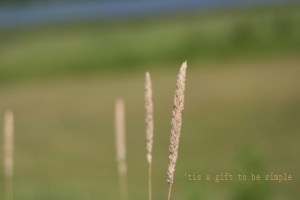
'tis a gift to be simple‘Tis the gift to be simple, ’tis the gift to be free
‘Tis the gift to come down where we ought to be,
And when we find ourselves in the place just right,
‘Twill be in the valley of love and delight.
When true simplicity is gained,
To bow and to bend we shan’t be ashamed,
To turn, turn will be our delight,
Till by turning, turning we come ’round right.
– Joseph Brackett (sung by Jewel)

Holy One
I walk the distance in my soul
The distance from distracted to quiet
The distance from scattered to whole
The distance from me to you.

Too often I forget that you are there
That you already surround and embrace me
That turning, turning,
Places me in your arms, in your quiet
In your delight – and in mine.

Bring me to that turning
Help me touch the quiet
Help me to embrace your simple gifts
Of love and delight
Of connection and deep peace.

I quiet my soul
I turn and lean in just the tiniest bit
And find I am resting my head upon your chest
And feel you wrap your holy spirit ’round me
This … this is home.

Thank you.
Amen.

[photo by Kate Ter Haar per cc 2.0]


Remembering grace

back fenceHello
Do you remember me?
I used to come to talk to you most every day,
Leaning across the back fence of your mind,
Picking at the splinters in the rail,
Looking up at the clouds with a cocked eye,
Wondering with you about the rain.

Do you remember
The sweet release of walking across campus on a spring day
When the sun was intense and the breeze cool?
When the sheer joy of being engaged in a project worth doing
Hung playfully in the air
And the energy of shared purpose kept us fully engaged?

Do you remember
When movement felt good?
When arms swinging, backpack singing, legs reaching,
Were part of the joy of the journey?
When the caress of walking through waist-high wildflowers
And their gentle, moist presence
Brought a soul-deep green into your day?

Do you remember
The sleeping child upon your lap
Whose unconscious move to snuggle deeper into comfort
Was also a deep comfort to you?
When the flash of curious question in their eyes
Fed your soul with wonder?
When spontaneous smiles erupted for bugs and stones and anything fuzzy?

Do you remember
The comfort of sitting quietly together
Watching the sunset?
When the palpable sense of belonging to each other
Made words redundant?
Do you remember the touch of love?

Do you remember me?
I still come to talk to you most every day,
I still pick at the fence and look at the clouds.

I do remember. Thank you.

I am grateful, today, for the call to remember the richness of my life.
I am grateful for these whispered memories
For each small glimpse of wonder and connection.
They feed my soul with grace, again,
Just as they did before.

[photo by Bunches and Bits {Karina} per cc 2.0]


Thinking Critically about Critical Thinking

reflective moment(Originally developed for Incoming Honors Students at UNT circa 2007)

As you engage with other members of the university community in the vital conversations that make the university an engine of change, I predict that you will encounter a temptation. The temptation is particularly keen in universities because part of the process of education is to engage in critical thinking. You learn not to take everything at face value. You learn to question and look for motives, patterns, misperceptions and errors. You learn to think beyond the obvious.

Yet, I believe there is a very real difference between critical thinking and being critical. When you make that subtle shift from analysis to negativity you set yourself up for the temptation of cynicism.

A cynic is one who takes the view that things are unalterably negative and that only a naïve fool would think differently. A cynic’s goal is to be the first one to find the fatal flaw. And cynicism has its advantages. You can be thought of as brilliant without having to invest in finding solutions. If you go ahead and write off the possibilities you can avoid a lot of effort and forego the risk of failure. After all, cynicism makes it seem wise to stop trying.

That’s why, in the end, cynicism is a poison to progress.

So, is that the choice: naïveté or cynicism? Of course not. We do not have to neglect careful scrutiny and in-depth analysis to avoid cynicism. What we have to avoid is tuning our lenses to see only the negative. We can look for the resonance as well as the dissonance.  And if dissonance is found, if a problem has been identified, we must commit ourselves to go the next step, to finding its hidden lessons.

Analysis, after all, can help us see connections as well as disjunctions. When we identify motives, we can find ways to build alliances. The more you examine the underlying structures, the better you can make them work. You see, the world is intimately interconnected and the more you can trace the connections, the more you see how your work is a part of the whole.

Perhaps what I am advocating is a mode of critical thinking with an optimistic flair, one that looks for patterns that work. Perhaps I’m just encouraging you not to stop half-way in the critical thinking process. I’m encouraging you to take it all the way to its creative possibilities. Otherwise you shortchange your education, you shortchange yourself, and you shortchange the future we are creating together.

[photo by João Pedro Nogueira per cc 2.0]

Are there two Christianities?

twoYeah, I know there are lots of denominations … and non-denominations. I know that everyone of us holds life with different hands. But it seems to me, of late, that there are two main branches. One is worried about the sorry state of our souls and the world at large. One sees beauty and the imprint of grace in each encounter. One sees the foundational story of the world as ‘the fall.’ One looks a bit earlier to ‘God saw that it was good.’

My soul has gravitated … or perhaps fled … to the hope of beauty. It has fled to the assurance of God’s creative love, to a redemption that does not deny that things can get ugly – but knows that everything, everything can be turned to good – that ‘all things’ can be turned to work in that direction. In fact, that all things are in the hands of one who can do – is doing – that turning. That ‘all manner of things will be well.’

Is it my own state of privilege that allows me the luxury of that view? Is it that I have not suffered the abuse that makes the ugly so evident? Is it that I have not borne the scars of hate upon my soul?

The thing that mitigates against the conclusion that this hope is a privileged mirage – is the cross. There is no travesty that can keep God’s love at bay. God loves the world that murdered the son. The son promised immediate paradise to the one who hung beside him – and prayed forgiveness to those who drove the nails.

There are some basics, here – faith, hope and love – these three.

The basics do not include guilt or fear. In fact, the trio, above, works to mitigate the fears that would hold me captive. Perfect love, you know, casts out fear. Faith is counted as righteousness.  Hope does not disappoint.

The starting point of my faith is not ‘all have sinned,’ as true as that may be. Instead my faith is born in ‘nothing can separate us.’

[photo by Rev Stan per cc 2.0]

What is the message of the cross?

cross
What is the message of the cross?
Not that God needed blood in order to be able to forgive,
But that no amount of rejection, violence or hate
Could keep God from forgiving.


How sad that even this most loving act
Has been reinterpreted as the requirement of a blood-thirsty god
Who is bent on vengeance unless he can be placated by death.
It tells us more about ourselves than we can bear to admit.

God did not drive the nails.
God endured it
And, sweet mystery, still offers to love and forgive.

Would that we could learn such love.
It is my greatest wish.
And God’s.

That is the message of the cross.

[cropped from photo by Adam Selwood per cc 2.0]

fireside conversation

embersHere we are, the friends of my ponderings and me. We are sitting around the fire on a cool night. The fire has died to glowing embers and the night sky spreads out above us, full of infinite stars and infinite majesty. We look up, and sigh, and begin a slow and thoughtful conversation about faith and doubt and how it is that we find our heart’s true home.

“Just what is faith?” I ask, feeling around the edges of my soul for an answer that seems sure – an ironic search, I know, but an earnest one.

“Faith is the assurance of things hoped for, the conviction of things not seen.” The words of the author of Hebrews come into my mind first as the ‘correct answer’ parroted by my Sunday school self, but as the words take shape in the cool night air, I can hear the essence of the very in-betweenness of faith – the knowing and not knowing.

“To one who has faith, no explanation is necessary. To one without faith, no explanation is possible,” muses Thomas Aquinas. I have to admit he sounds a bit smug. Maybe it’s just my ears.

‘Faith is an oasis in the heart which will never be reached by the caravan of thinking,’ Khalil Gibran nods in response. Again, the words seem pretty, but a bit foreign.

Sharon Salzberg makes it more personal, and more real, at least for me. “[Faith] is that movement of our heart that says, ‘Yes, this can be for me.’”

“Faith means an abiding trust that the way things are working out is part of something bigger and probably incomprehensible, but just knowing that it’s part of a larger constellation of meaning, it is a kind of comfort and a kind of succor and solace for a Jew.” Rabbi Lawrence Kushner, leans in closer to the fire. The reality of the Jewish experience gives his words a somber substance.

Anne Lamott chimes in, “Faith is a verb. … I don’t know what I’m going to see along the way, but I know that I’ll be sustained and I know I won’t be alone.”

Frederick Buechner takes up that theme, “Faith is better understood … as a process than as a possession. It is on-again-off-again rather than once-and-for-all. Faith is not being sure where you’re going, but going anyway.”

Richard Rohr nods, “Faith is more how to believe than what to believe … an initial opening of the heart … our small but necessary ‘yes.'”

“Faith is a living, daring confidence in God’s grace, so sure and certain that a man could stake his life on it a thousand times.” This bracing challenge from Martin Luther, who lived that reality.

His namesake, Martin Luther King, Jr., also has some experience in living the challenge. “Faith is taking the first step, even when we can’t see the whole staircase.”

I suddenly feel intimidated, sitting in the presence of those who’ve walked the plank of faith so much further than I’ve even dared to imagine. All of my doubts crowd in around me – doubts about my own faith, that, in self-protection, disguise themselves as doubts about the doctrines and ‘truths’ I’m supposed to believe. I sigh and shake my head.

Sharon Salzberg seems to sense my quandary and gives this assurance, “Questioning means longing to know the truth deeply and insisting that we can.”

The rabbi chimes in again, quoting his teacher, Samuel Sandmel, with a chuckle, “If you don’t seriously doubt the existence of God every couple of weeks, you are theologically comatose.” It is as if the willingness to seriously entertain doubt is the only way to hold on to faith.

This brings a chorus of assent, from Miguel de Unamuno, who suggests that “Faith which does not doubt is dead faith.”

Paul Tillich nods, “Doubt isn’t the opposite of faith; it is an element of faith.”

Voltaire acknowledges, “Doubt is not a pleasant condition, but certainty is absurd.”

Then, Robertson Davies takes that a step further, and with a sinister and all-too-politically-relevant observation, “Fanaticism is…overcompensation for doubt.”

“So, wait … is doubt good or bad?” I ask.

“Doubt is real,” comes the answer. “It is only good if you acknowledge it and use it to shine a light into unexplored corners. It turns cancerous when you either let it paralyze you or you try to deny it, entirely.”

“One of the challenges with the concept of faith is that it is too easily framed as belief. We think it rests most firmly in our heads. In fact, this whole conversation has been rather heady. But faith lives most vibrantly in our hearts. It is what we rest our hearts upon. It is what we most deeply trust. And when we move forward, based upon that center, we are moving in faith. Indeed, all of us have faith in something, else we could not move at all. And when we move, despite our doubts, we gather confidence in that deep center.”

Someone rises to put another log on the fire. We watch as the flame grows around it.

“See, just what I was saying.” And everyone nods.

[photo by Jon Scally per cc 2.0]

{Thank you to Krista Tippett and On Being for the seeds of this conversation.]
Christians are the proof of Easter

caring handsChristians are the proof of Easter,
Much more than the empty tomb.
It’s not so much where Christ is not …
It’s where Christ is.

It’s where His body is, today.
And what He’s doing in the world
With our hands and feet and voice …
Which are, of course, now His.

(Ok, so I have to say I find this pretty intimidating.)

[photo by Randen Pederson per cc2.0]
[This saying, ‘Christians are the proof of Easter’ comes from a third grader in a Sunday school class I taught some 40 years ago, when I asked the class, ‘What do you think was the proof of the resurrection?’ and he answered, with excitement, ‘Christians!’]
[St. Theresa of Avila gives us the quote that Christ has no hands but ours.]

Resurrection of hope

sunrise

These words, whispered in my ear this morning:

Do you see, my little one,
The ribbon of red along the horizon?
Do you feel the rush of mystery,
Touched by the fingers of the sun as it rises?

Do you not know, deep in your soul, that my love for you
Is too deep for hope to be forever lost?
Take heart. Take my heart.
My hope for you will not stay in the tomb.
My hope for this world cannot be contained.
There is no crucible from which it cannot rise.

The depth of pain,
The nails of hate,
Even the denial of friends
Cannot hold the folds of darkness so firmly
That they refuse the new day,
Which is rising, even now.

And so, here is my blessing for you, this Easter morning:

May you rise from the many deaths you have encountered, strong and full and free
For this is the path I have opened for you.
My you hold my light of hope for the world to see.
May your fingers join the sun in searching out the mystery.
May you grasp hope as your talisman, as the abiding assurance of my love
That each day, each day, reaches out to you from the far horizon.

It is time for a resurrection.

Take it into your heart,
That I might live in you
That you might live in this world
And live it into resurrection, too.

[edited from photo by Sean MacEntee per cc 2.0]
[see also DONE! and Done]

Irrigating Prayer

cracked earth
Prayer irrigates the earth and heart
– St. Francis / Love Poems from God – Daniel Ladinski


How does prayer water my soul?
How can it soften the cracks that have yawned so wide?
How can it fill those holes in me that echo with despair?

What part of the whole am I?
What is diminished when I turn away?
What holes do I leave in that leaving?

When will I learn to listen to your voice?
When will I open to your presence?
When will you come?

Where is the quiet space that lets life blossom?
Where are the thin places in my life, in my soul,
Where I can find you, if I’ll seek, knock, ask?

Why does my prayer sound echoes in my soul?
Why can I not connect to your grace and fullness?

Why won’t you answer me, this morning?

Does prayer answer my questions, or, in acknowledging them,
Do I open myself to the rain of your grace?
Can you sneak up behind me and catch me with a hug?

I so need your embrace, and with my prayer, this morning,
I embrace my need as the very opening that makes the space for you;
The crack in my soul where you can enter.

Will you enter?

[photo by Anjan Chatterjee per cc 2.0]


magnificent heart

spring flowers


We are silly little creatures.
Why would you concern yourself with us?
Why turn your magnificent heart toward such tiny trinkets?


It’s not the pull of the trinkets.
It’s the nature of your magnificent heart
To touch the soul of each little thing
And bring it to
Its full and glorious self.

Life calls to life.
Love calls to love.
Beauty calls to beauty.
You call to me.

[photo by Mike Bizeau from his wonderful photo blog, Nature has no Boss, used with permission]