
 “Tell me again, Uncle Zach, tell me the story of the angel, when you were in the temple.” Jesus is staying over for a few days and is helping his uncle with his work.
John rolls his eyes and looks at his cousin. Not again. John is intimidated by the story. It is his father’s story, but the weight of it rests on him. ‘The spirit and power of Elijah’ the angel had said. Sometimes, in the quiet, John felt inside himself for the stirrings of this prophecy, fingering his own soul, looking for signs of Elijah or of any real power at all. Nothing. So, he hides a secret fear that he will fail the prophecy. Hearing the story only makes it worse.
Jesus and John are eleven, old enough to know that their stories are both unique, not old enough to understand what that difference may yet mean.
Zechariah begins the story and Jesus settles in beside him. John is across the room, finishing up his chores so he can leave as quickly as possible. They have both heard the story before, but not often. It is hard on a family to hold the weight of such a story and Jesus’ siblings aren’t very fond of it, or of the other story that follows. But today it is just Zechariah and Jesus and John inside, so the time seems right to tell it again, in detail.
Zechariah takes a deep breath and begins. When he starts the story he is looking straight at Jesus. “You know how it works,” he says. “When it is time for my division to bring the incense into the Holy Place, we draw lots. It is our way of letting God pick the servant. It is an honor for the lot to fall to you. And when I was chosen, I felt, as I always do, a slight rush of pleasure that I am the one that God wants this day. God’s call to the priestly tribe is a precious gift. God’s call to a single one . . . to me . . . or to you . . . is . . . a wonder.”
By now Zechariah is no longer looking at the boys. John and Jesus are both listening, pulled by what he is saying, by its echo in their hearts. There is deep quiet in the room. “I went into the Holy Place, into that place that God has chosen to be present. You think you are prepared when you go in – but the Presence hits you and, every time, you know that there is no way that you will ever really be ready for that place. It always takes me a moment. Like letting your eyes adjust to the darkness when you enter a cave on a bright day – or more – how your eyes adjust when you go back into daylight from the cave. So, I wait at the doorway for my soul to catch its breath. And then, when I find my legs again, when I can move, I take the incense to the altar.”
“The Presence is most strong that day. It is as if I am not the only one touching the Presence. The Presence is always magnified in my heart when someone next to me is touching it, as well. It was that sense, but more, that day. As I approach the altar, I suddenly know why. There is an angel standing there. Once he appears, he is powerfully real . . . as if I were the vision and he the substance . . . but even more, he is touching the Presence so powerfully that I am overcome. I start to tremble, almost to fall. He reaches out and catches my arm. He takes the incense from my hand and places it on a bench next to the altar and tells me not to be afraid. I wonder why he says that . . . it’s not fear that I feel. In fact, I hardly am aware of myself enough to feel anything at all. But his words draw my attention back to myself and I can see that I am trembling.”
“We sit together on the bench, with the incense between us. He looks me in the eye and waits till I have calmed myself a bit. Then he speaks to me, ‘Don’t be afraid, Zechariah.’
“He says my name. My name. He was waiting there specifically for me. Now I do start to feel the fear. He sees my eyes widen and he takes my hand, “Zechariah, your prayer has been heard.”
“Now, boys, you have to know that I had not really been praying when I came into the temple. I had been too busy with the preparation, with the responsibility. I was sitting there, wondering what prayer he was talking about.”
“‘Your wife, Elizabeth, will bear you a son,’ he says, quietly, waiting for the words to sink in.”
“My heart shakes itself. Oh, that prayer! The prayer that was on my lips for so many years, but had slowly, with age, become just an echo in the deep recesses of my heart.” Here Zechariah stops and looks at John, saying, without words, how much the boy had been their prayer. John looks away, feeling the weight of one more burden, one more way to disappoint.
“And then,” Zechariah continues, still looking at John “then the angel smiles. ‘You will have joy and gladness and many will rejoice at his birth.’ The angel bends forward. There is a joyous urgency to his manner. ‘Your son will be great in the sight of the Lord. He will drink neither wine nor strong drink. He will be filled with the Holy Spirit even from his mother’s womb, and he will turn many of the children of Israel to the Lord their God. He will go forth in the spirit and power of Elijah to turn the hearts of fathers toward children and the disobedient to the understanding of the righteous, to prepare a people fit for the Lord.’ By this time the words are feeling triumphant.”
“My own heart is on a double track. Part of it surges with new hope, eager to receive this news and take it to Elizabeth; thrilled to think that the power of the prophets might return to our poor land. The other part, well, I’m not sure. How can I be a part of such a plan? We both are old. And Elizabeth . . . oh, my . . . if I were wrong, and raised this hope to dash it once again . . . I’m not sure she – or I – could bear it. So, I yearn for the promise while I fumble in fear that it just cannot be so. ‘Are you sure?’ I grasp the angel’s sleeve. ‘I’m not . . . Elizabeth is not . . . we are both too old.’”
“The angel pulls away, looking suddenly stern. ‘Am I sure? Am I sure? I AM is sure, is giving you this promise! How can you doubt the word of God?’”
“I am looking at my hands. ‘It’s not that I doubt God; it’s that I cannot trust myself. I know, too well, my frailty.’”
“Gently now, the angel takes my hands. ‘It is that very frailty that reveals the power of God. Can you not see? It is the barren womb that shows God’s power most clearly. Will you fail to go to your wife? Will she fail to conceive? Will the baby refuse to be born, to grow? Do what you can do. God will do the rest. Your very frailty will show God’s presence in this gift. You were not chosen at random, but carefully nurtured into your role. And now, because you need to see how frailty speaks, you will be mute until his birth.’”
“Some thought it was a punishment for my lack of faith, that I was mute. But really, boys, there were no words to capture what I’d seen. Who would have believed me, anyway? My loss of words told them I had seen a vision, yet it let me save my secret for Elizabeth. We savored that time alone with the secret of God’s power, till it could be hidden no longer.”
“Your circumcision, John, released my tongue, released the story into your life. I know you feel its weight. But do not fear. It’s like the angel said, frailty does not matter. God requires nothing but our obedience. You do what you can do. Then, you wait to see what happens. You let God shine through your frailty. And you rejoice.”
Zechariah is smiling. John comes round the table to stand for just a moment beside his father. Then he pokes Jesus in the arm and chases him out the door. They shake off the quiet and melt back into their eleven-year-old lives.
12 5 03
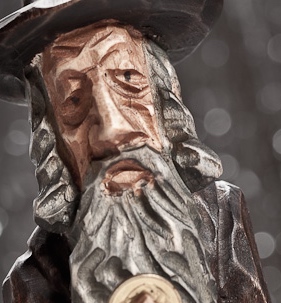
[photo cropped from ‘the Rabbi’ by Rafal Kiermacz under cc 2.0 ]
[You can listen to an audio version of this story, narrated by Boyd Barrett, a dear friend, on his site. You may also want to explore his other podcasts – you’ll be glad you did.]



 Quiet Hope